Dewatering Project: Multi-Stage Treatment of Construction Dewatering Water
An environmental services company was contracted to treat dewatering water generated during excavation activities. Analytical sampling identified elevated concentrations of oil and phosphate that exceeded discharge criteria and required treatment prior to discharge.
A multi-stage treatment system was designed to address the identified contaminants while operating at a continuous flow rate of 250 gallons per minute (gpm). The system combined chemical treatment, conventional filtration, and Hydrosil adsorption media to provide a comprehensive approach to water treatment.
The system operated continuously for approximately three weeks and successfully treated nearly 6,000,000 gallons of dewatering water.
The Challenge: Treating Contaminated Dewatering Water
Construction and excavation projects can generate substantial volumes of water that require treatment before they can be discharged. Depending on site conditions, dewatering water may contain a range of contaminants that must be reduced to meet project-specific discharge requirements.
For this project, analytical sampling identified oil and phosphate as the primary contaminants of concern. Because both contaminants required treatment, the system was designed with multiple treatment stages rather than relying on a single filtration or treatment method.
This approach allowed the water to be progressively treated as it moved through the system, with each stage serving a specific purpose.
Multi-Stage Water Treatment System
The treatment train used a multi-stage approach that included:
- Chemical Treatment
- Settling Tank
- Sand Filter
- Bag Filter
- HS-200 – 40,000 lbs
- HS-300 – 10,000 lbs
The combination of chemical treatment, settling, filtration, and adsorption provided multiple treatment steps before the water reached the final discharge point.
Chemical Treatment and Settling
The initial chemical treatment and settling stages were used to condition the water and remove contaminants and solids that could be separated before the water reached the downstream filtration media.
The settling tank provided an additional opportunity for solids separation and helped reduce the contaminant loading entering the filtration stages.
Sand and Bag Filtration
After chemical treatment and settling, the water passed through a sand filter followed by a bag filter. These filtration stages provided additional physical filtration before the water reached the Hydrosil media. Removing suspended material and other particulate matter upstream can help reduce the loading on downstream filtration media and allow the adsorption stages to focus on the contaminants they were selected to treat. Most systems utilizing a bag filter upstream of Hydrosil’s media consists of a 5-micron filter. A 5-micron filter removes large enough particles to keep the vessels and Hydrosil media from plugging.
Hydrosil Adsorption Media
The final stages of the treatment system utilized two Hydrosil media products in series: HS-200 and HS-300.
A total of 40,000 pounds of HS-200 and 10,000 pounds of HS-300 were incorporated into the treatment system.
Using different media in series allowed the system to address the two primary contaminants identified during analytical sampling.
HS-200
HS-200 was incorporated into the treatment train to address the oil contamination identified in the dewatering water.
As an organoclay-based water filtration media, HS-200 is designed for applications involving oil and other organic contaminants. Its use in this project provided a targeted adsorption stage following the chemical and physical filtration steps.
HS-300
HS-300 was incorporated as the downstream adsorption media to address the phosphate contamination identified in the water.
The use of HS-300 alongside HS-200 allowed the treatment system to utilize different media characteristics to target different contaminants within the same water stream.
Theoretical Media Calculations
The HS-200 and HS-300 Hydrosil media were operated in series. The theoretical calculations below are based on the average concentrations of oil and phosphate identified across the three samples provided for the project.
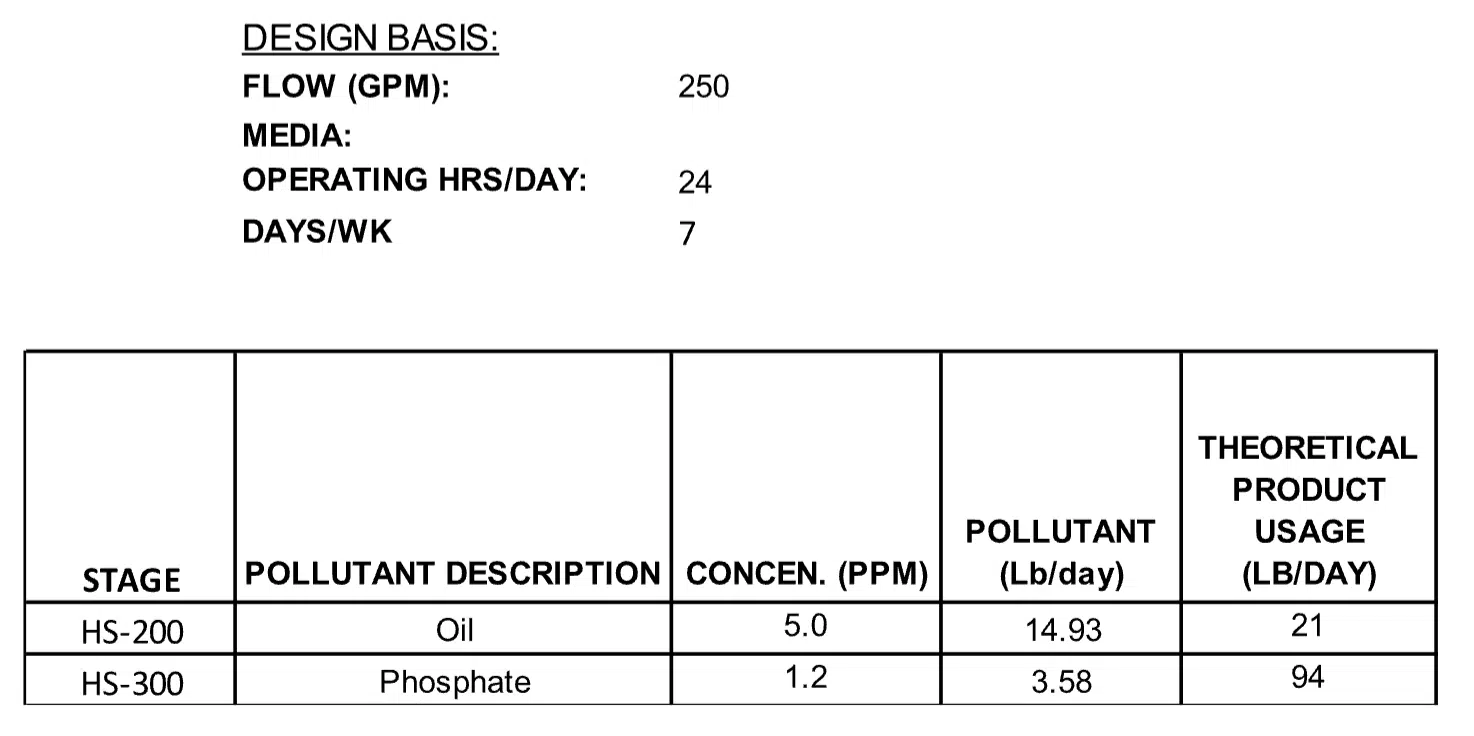
The calculations provided a basis for evaluating the anticipated performance and media requirements for the treatment system. The final system incorporated 40,000 pounds of HS-200 and 10,000 pounds of HS-300 and was operated continuously throughout the project.
Treatment Performance
The treatment system operated continuously for approximately three weeks, successfully treating nearly 6,000,000 gallons of dewatering water.
Final effluent sampling was conducted on the last day of operation. The results were:
- Oil: 0.1 ppm
- Phosphate: 0.05 ppm
These final results confirmed that the system continued to perform through the end of the project.
The project demonstrated:
- Sustained adsorption performance
- No observable breakthrough at shutdown
- Effective integration of chemical and adsorption treatment stages
- Successful treatment of nearly 6 million gallons of dewatering water
- Compliance with the project’s discharge requirements
A Multi-Stage Approach to Construction Dewatering
This project demonstrates the value of combining multiple treatment technologies when addressing contaminated water generated during excavation and construction activities.
Rather than relying on a single treatment method, the system incorporated chemical treatment, settling, sand filtration, bag filtration, and targeted Hydrosil adsorption media. Each stage played a role in preparing the water for the next treatment step and addressing the specific contaminants identified through analytical sampling.
The approach also demonstrates how water filtration media can be integrated into larger water treatment systems to address specific contaminants within a high-volume water stream.
For environmental contractors and engineers working on construction dewatering, contaminated water, or other industrial water treatment applications, selecting the appropriate treatment media based on the contaminants present can be an important part of achieving the required effluent quality.
Results
Over approximately three weeks, the treatment system successfully processed nearly 6,000,000 gallons of dewatering water at a continuous flow rate of 250 gpm.
Final effluent sampling showed:
Oil: 0.1 ppm
Phosphate: 0.05 ppm
The results confirmed sustained treatment performance through the final day of operation, with no observable breakthrough at shutdown and final effluent that met the project’s discharge requirements.
This project highlights how Hydrosil media can be incorporated into a custom water filtration and treatment approach to address specific contaminants in high-volume applications.
Hydrosil Water Filtration Media
Hydrosil provides specialty water filtration media for a variety of environmental and industrial applications. Media selection can be tailored to the contaminants present, treatment objectives, flow requirements, and overall treatment system.
For projects involving construction dewatering, contaminated water, industrial water treatment, groundwater treatment, or other water filtration applications, Hydrosil can help identify an appropriate media solution based on the specific characteristics of the water.
Have a dewatering or contaminated water treatment project? Contact Hydrosil to discuss your application and determine the appropriate filtration media for your treatment system.